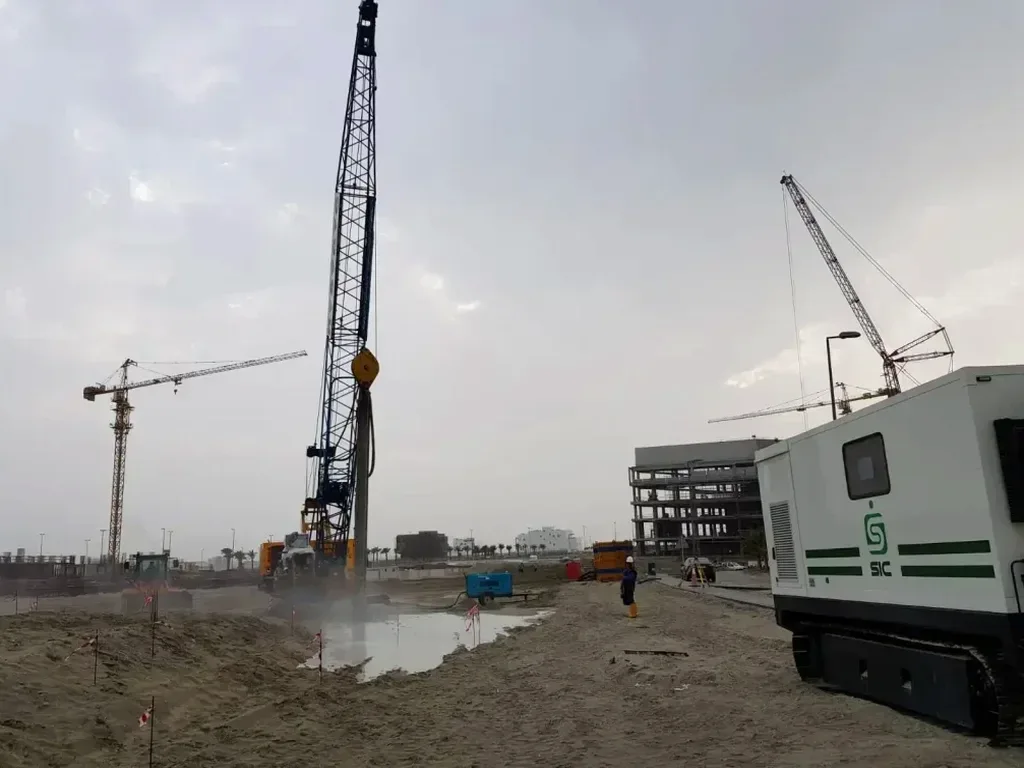
A deep vibrator suspended from a crawler crane is a familiar sight on Wellington construction sites, its resonant hum a sign that loose, problematic ground is being methodically densified. This equipment, capable of reaching depths of over 20 metres, transforms unstable granular soils into competent founding strata by rearranging particles into a denser state. In a city where flat, buildable land is squeezed between steep hills and a dynamic harbour, the value of ground improvement cannot be overstated. The vibrocompaction process involves penetrating the ground with a vibratory probe and systematically compacting the surrounding soil column, often with backfill added to make up for the lost volume. Our team has applied this technique across the region, from the reclamation zones of CentrePort to residential subdivisions in the Hutt Valley, tailoring each design to the specific grain-size distribution and seismic demands of the site. Complementing this deep compaction work, on-site verification often includes a CPT test to quantify the achieved density increase and confirm that project specifications have been met.
Effective vibrocompaction in Wellington is less about brute force and more about precise energy delivery tailored to the grain-size curve and the site's specific seismic performance requirements.
Our approach and scope
The New Zealand seismic environment, codified in NZS 4203 and the geotechnical modules of NZS 3404, places rigorous demands on ground improvement design, particularly in a city as seismically active as Wellington. The vibrocompaction design process here must explicitly account for the near-fault effects and long-duration shaking that define the Wellington region's hazard profile. Our approach begins with a detailed analysis of the in-situ material: the fines content must be below 12 percent for effective densification, and the grain-size curve is critical for selecting the vibrator's frequency and amplitude. We develop a compaction grid, typically on a triangular spacing of 1.8 to 3.0 metres, designed to achieve a target relative density of 70 to 85 percent, which is essential for mitigating liquefaction in the sandy soils common to the city's coastal margins. The design is validated against the NZGS guidelines for ground improvement, ensuring that post-treatment performance meets the stringent serviceability and ultimate limit state criteria demanded by Wellington City Council.
Common questions
What type of soil is suitable for vibrocompaction in Wellington?
The technique is ideally suited to loose, clean granular soils with a fines content below 12 percent, such as the sands and gravels found in Wellington's coastal reclamations and alluvial plains. If the soil has too much silt or clay, the vibratory energy is dampened and the particles cannot be effectively rearranged. A thorough grain-size analysis is the first step in determining feasibility.
How deep can vibrocompaction treat the ground in the Wellington area?
Standard crawler cranes in our fleet can treat depths of 15 to 22 metres, which covers the typical depth of loose Holocene sediments in the Wellington basin. For deeper deposits, we can mobilise a more powerful 300 kW vibrator with a custom leader extension, reaching depths beyond 25 metres, though this is rarely necessary for most building projects in the city.
Can vibrocompaction completely eliminate liquefaction risk in a Wellington earthquake?
In suitable granular soils, vibrocompaction is one of the most effective methods for mitigating liquefaction by increasing the soil's relative density and cyclic resistance ratio. We design to a target post-treatment density that, per the NZGS guidelines, reduces the factor of safety against liquefaction to well above 1.2 for the design earthquake. While it drastically reduces the risk, no ground improvement can offer an absolute 100 percent guarantee against an extreme, beyond-design-basis event.
What is the typical cost range for a vibrocompaction design and testing package in Wellington?
For a standard residential or light commercial site requiring vibrocompaction design, pre- and post-treatment CPT verification, and a performance report, the fee typically ranges from NZ$2.290 to NZ$8.040. The total project cost will also depend on the treatment area's size, depth, and the contractor's mobilisation charges, which are separate.
How long does the design and verification process take from start to finish?
The initial feasibility study and grid design can be completed within five to eight working days after receiving the site investigation data. The on-site compaction work is the contractor's scope, but our post-treatment verification CPT testing is usually performed within 48 hours of compaction completion, with the final report issued within a week. A typical project cycle from instruction to final sign-off is two to three weeks.