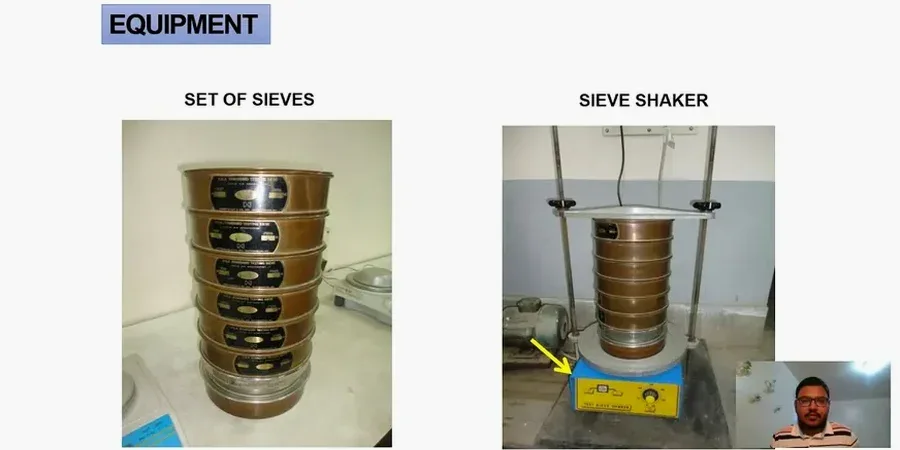
Plenty of sites across Wellington look straightforward until the first test pit reveals a mix of weathered greywacke gravels and silty fines. That blend plays a huge role in drainage, compaction, and how a foundation will perform over time. A proper grain size analysis gives you the full curve, from coarse fraction right down to the sub-75-micron range. Our lab runs the combined sieve and hydrometer method following NZS 4402, which means the result is a single continuous particle size distribution plot. For cut-and-fill work on the Town Belt or deep excavations near Lambton Quay, we often pair this with an Atterberg limits test when the fines fraction exceeds 12%, because plasticity can shift the soil classification from a silt to a clay without the gradation curve changing much. The hydrometer side takes a full 24-hour reading cycle, so turnaround is never same-day, but the data density is worth the wait.
A single combined curve spanning 75 mm down to 2 microns gives the engineer more decision-making data than any two tests run separately.
Our approach and scope
Wellington sits on a faulted landscape where the 2016 Kaikōura earthquake reminded everyone how quickly soil behaviour can shift across a single section. Particle size distribution testing is central to the NZGS soil classification framework used here. The procedure splits at the 2.36 mm sieve: material retained goes through a stack from 75 mm down to that point, while the minus-2.36 mm portion is split for a 152H hydrometer sedimentation test. We use sodium hexametaphosphate as the dispersant, calibrated against a thermometer reading taken at the start of each timed interval. The sedimentation cylinder sits in a water bath held at 20°C in our Thorndon lab, compensating for Wellington's often fluctuating ambient temperature. The final report includes a D10, D30, D60 triplet, the coefficient of uniformity Cu, and the coefficient of curvature Cc, plotted on a semi-log graph that makes gap-graded or well-graded assessments immediate. When the material is a silty gravel typical of the Wellington Fault scarp, the combined curve often reveals a bimodal distribution that a simple sieve-only test would miss.
Local ground factors
Te Aro and Thorndon sit on reworked alluvium with a high silt fraction, while Karori and Kelburn often hit residual greywacke soils where the coarse fraction dominates. The risk of misclassifying a soil jumps when the gradation curve is based on sieve data alone. A silty sand with 18% fines may plot as a well-graded sand on sieve results, yet the hydrometer reveals enough low-plasticity silt to trigger a different liquefaction susceptibility category under the MBIE/NZGS guidelines. That single parameter shift can alter the required ground improvement strategy and the consent pathway. On the Hutt Valley side, where river gravels intermix with estuarine deposits, gap-graded curves are common, and they correlate with internal instability in filter design. When the Cu value exceeds 20 and the Cc falls outside the 1-to-3 range, the material often fails the Kezdi or Sherard internal stability criteria, which has direct consequences for drainage blanket specification behind retaining walls on steep Wellington sections.
Common questions
How much does a combined grain size analysis cost in Wellington?
The combined sieve and hydrometer test typically runs between NZ$200 and NZ$290 per sample, depending on whether the material is predominantly coarse or fine and whether additional preparation like oven-drying and pulverising is needed. Bulk pricing applies for five or more samples from the same project.
What is the difference between a sieve-only and a combined analysis?
A sieve-only test stops at the 75-micron sieve and reports everything passing as 'fines'. The combined analysis continues with a hydrometer sedimentation test that measures particle sizes down to approximately 2 microns, splitting that fines fraction into silt and clay percentages. Without the hydrometer, a silty sand and a clayey sand can look identical on paper but behave completely differently in terms of drainage and volume change.
How long does the hydrometer part take?
The full sedimentation test requires a 24-hour reading cycle per sample. Readings are taken at prescribed intervals: 0.5, 1, 2, 5, 15, 30, 60, 250, and 1440 minutes. After the final reading, the sample is oven-dried and weighed to back-calculate the percentage finer at each time step. Including the sieve portion, a combined report is typically ready within three working days.
Which Wellington soil types need the hydrometer test most?
Any soil where the fines content visible in a hand specimen appears above 12% should have the hydrometer run. Wellington harbour sediments, reworked loess on the hills, and the silty alluvium found in Te Aro and along the Hutt Road corridor all fall into this category. The hydrometer data is also essential for liquefaction screening under the MBIE/NZGS Module.
Do you report the coefficient of uniformity and curvature?
Yes, every combined report includes the full set of derived parameters: D10, D30, D60, the coefficient of uniformity Cu (D60/D10), and the coefficient of curvature Cc (D30² / [D60 × D10]). These numbers are calculated directly from the plotted curve and included on the graph alongside the NZGS soil group symbol.