A total station or GPS rover is the first instrument set up on a Wellington retaining wall job. You need precise coordinates before modeling the stem, heel, and toe geometry. Our team works directly from survey data, factoring in Wellington's notorious greywacke slopes and the Wellington Fault hazard zone that runs right through the Hutt Valley and across the harbour. We model the soil parameters in the lab, then run load cases in GEO5 or PLAXIS. The output is a signed design package that includes reinforcement schedules, drainage details, and construction staging notes. Everything references the current NZS 3404 for steel and NZS 4203 for seismic actions, and we apply the NZGS guidelines for backfill selection behind the wall. For deep basements on Lambton Quay or compact residential sites in Thorndon, we often pair the design with a cpt test to get a continuous stratigraphic profile before finalizing earth pressure coefficients.
A Wellington retaining wall design must survive both a 1-in-500-year earthquake and a week of southerly rain without the backfill turning to slurry.
Our approach and scope
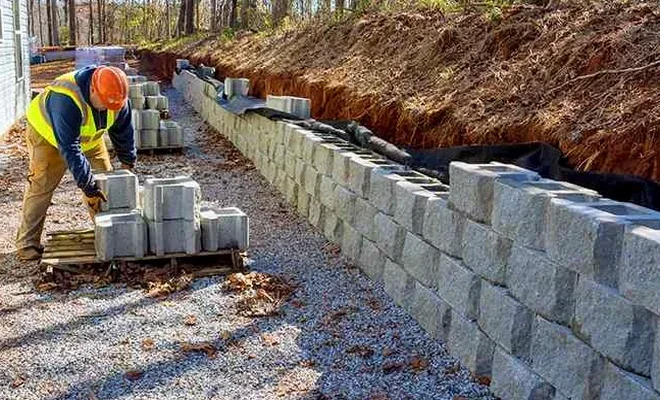
Wellington's 2016 Kaikōura earthquake reminded everyone that ground accelerations here are not textbook numbers. With a population of around 215,000 spread across a peninsula that drops from 495-meter Mount Kaukau to the harbour, retaining walls in this city routinely face 25-degree slopes and weathered bedrock at shallow depth. Our design approach starts by classifying the retained material in the laboratory: grain size distribution, Atterberg limits, and direct shear strength. We then set the wall geometry to respect the council's earthworks consent thresholds. Cantilever walls in reinforced concrete are common, but segmental block and crib walls also appear in lower-risk backyards. We specify drainage aggregate gradation that complies with NZTA M/6, and we detail subsoil drains that discharge to the street or to a soakage system if the underlying alluvium allows it. The seismic coefficient comes straight from NZS 1170.5, and we check sliding, overturning, bearing, and global stability for each design scenario.
Local ground factors
NZS 4203 and its successor NZS 1170.5 spell out exactly what Wellington walls are up against: Zone 4 seismic hazard, amplified further by ridge-top and steep-slope site effects. A retaining wall that fails during a Cook Strait event doesn't just crack; it can dump cubic metres of fill onto a road or a neighbouring property. The biggest risk we see in Wellington isn't structural failure of the stem — it's inadequate drainage. When the southerly fronts park over the Tararuas for three days straight, hydrostatic pressure behind the wall climbs fast. If the drainage blanket was skipped or the filter fabric was wrapped wrong, the wall goes from stable to leaning in a single storm. That's why our designs always include a positively drained system, and we specify compaction control for the backfill in 150 mm lifts. On sites with existing landslides or colluvium deeper than 2 metres, we add a global stability check using Spencer's method before the wall is even drafted.
Common questions
Do I need a building consent for a retaining wall in Wellington?
Wellington City Council requires building consent for any retaining wall taller than 1.5 metres, or any wall supporting a surcharge such as a driveway or building. Walls under 1.5 m still need to comply with the District Plan and may require resource consent if they are close to a boundary or in a heritage area.
What does retaining wall design cost for a typical Wellington residential site?
For a standard residential wall in Wellington, design fees typically range from NZ$1,900 for a simple gravity wall up to NZ$6,120 for a taller cantilever wall with full seismic analysis and producer statement documentation. The final figure depends on wall height, ground conditions, and consent requirements.
How do you handle seismic loads in Wellington retaining wall design?
We apply the seismic coefficients from NZS 1170.5 based on the site subsoil class and hazard factor for Wellington (Zone 4). The design checks sliding, overturning, and bearing capacity under both static and seismic load combinations. For walls over 3 m or on sloping sites, we run a pseudostatic slope stability analysis to confirm global stability.
What drainage is required behind a Wellington retaining wall?
We specify a continuous subsoil drain at the base of the wall, wrapped in a geotextile filter sock, with cleanouts at each end. The backfill must be free-draining granular material meeting NZTA M/6 AP40 or AP20 gradation. On sites with heavy clay, we often add a chimney drain against the cut face to intercept groundwater before it reaches the wall.