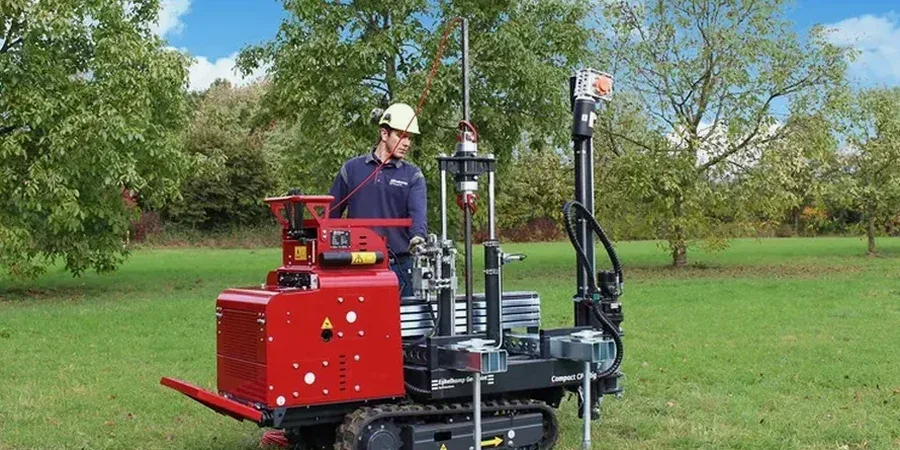
In Wellington we rarely see straightforward ground. The city sits on a mix of weathered greywacke, alluvial gravels, and harbour reclamation that shifts behaviour within a few metres. A standard borehole often misses what’s happening between samples. That’s where the CPT comes into its own — a cone penetration test pushed at 20 mm/s gives us a virtually continuous profile of tip resistance, sleeve friction, and pore pressure, all logged in real time. Our team runs a 20-tonne tracked rig that handles tight access in Thorndon, Karori, or up the Hutt Valley. Because Wellington’s seismic hazard is well documented (the Wellington Fault runs right through the region), understanding thin soft layers or liquefiable silts isn’t optional — it’s the difference between a foundation that holds and one that settles unevenly after the next decent shake. We often pair CPT data with liquefaction assessment on waterfront projects, where the reclamation fill over natural harbour mud creates a stratigraphy that’s notoriously tricky to characterise with rotary drilling alone.
In Wellington’s reclaimed land, a CPT log often reveals a 300 mm silt layer that a borehole missed — and that layer is what controls settlement.
Local ground factors
The single biggest mistake we see on Wellington sites is assuming that a few SPT blows at 1.5 m spacing tells the whole story. In the Te Aro basin, for example, thin lenses of loose sand sit inside what looks from a distance like uniform alluvium. Conventional drilling smears those lenses across the sampler, and the lab never sees them. A CPT picks them up instantly — pore pressure drops, tip resistance dips, friction ratio spikes — and suddenly you’re looking at a drainage path or a liquefaction trigger layer that wasn’t on the geotechnical model. We’ve been called in after foundation pour when differential settlement appeared within six months; the original investigation simply didn’t have the vertical resolution. Wellington’s seismic environment amplifies this risk. A 1-in-500-year event doesn’t care about your budget contingency — it cares about the weakest 200 mm in the profile. Running CPT early, even on modest residential builds in hill suburbs where fill depth is unknown, is cheap insurance compared to underpinning later.
Common questions
How much does a CPT test cost in Wellington?
For a standard single CPTu sounding in the Wellington area, budget between NZ$250 and NZ$390 per metre pushed, depending on access conditions and depth. The final figure includes rig mobilisation, the push itself, data processing, and a NZGS-compliant log sheet. Sites with steep access, tight CBD lanes, or hard refusal at shallow depth may alter the rate, and we always confirm pricing after a brief site walkover or photo review.
Can you run CPT in Wellington’s greywacke bedrock?
No — and no one can. Cone penetration testing is designed for soils, not rock. We push until refusal, which in Wellington often means hitting the weathered greywacke surface. At that point you get a clean refusal signature, and we record the depth precisely. If you need information below the refusal horizon, we recommend switching to spt-drilling from that depth to log the rock quality designation (RQD) and recover core.
When will I receive the CPT results and data?
We process raw CPT data the same evening or by the next morning. You’ll typically receive a preliminary SBT plot and key parameters by email within 48 hours of the test. If you’ve requested a full interpretative report with liquefaction screening and derived geotechnical parameters, that adds two to three working days. For urgent CBD projects we can prioritise turnaround — just mention it when booking.
What’s the difference between a CPT and a borehole with SPTs?
A borehole with standard penetration testing gives you discrete samples at intervals (usually 1.5 m) and disturbed samples for lab classification. A CPT, by contrast, provides a continuous profile of soil behaviour — tip resistance, friction, and pore pressure — without ever extracting a sample. The trade-off is that CPT doesn’t give you a physical specimen to look at or test in the lab. In Wellington practice, the two methods work best together: CPT fills the gaps between SPTs, and the SPT samples calibrate the CPT soil behaviour type classification.