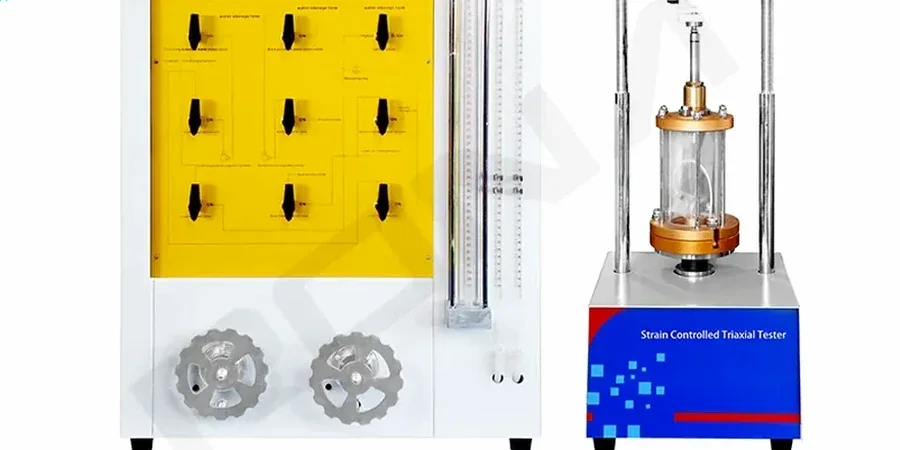
A nine-storey structure on The Terrace required excavation into highly jointed Wellington greywacke, and the design team needed reliable effective stress parameters to model retaining wall performance under seismic load. That is where a properly staged triaxial test program becomes indispensable. Unlike simpler index tests, consolidated-drained and consolidated-undrained triaxial stages replicate the in-situ stress path, providing the cohesion and friction angle data that feed directly into NZS 3404 and NZGS guideline-based analyses. For a city shaped by the Wellington Fault and underlain by variable fill over weathered bedrock, getting these parameters right determines whether a foundation behaves predictably during a magnitude 7 event. We run the full suite — from specimen trimming through saturation and shearing — inside an ISO 17025 accredited laboratory, and the results integrate naturally with the CPT testing and borehole logging campaigns that define a typical Wellington site investigation.
Triaxial testing in Wellington is less about the test itself and more about selecting the right consolidation stress and drainage condition to match the site’s loading history.
Local ground factors
Wellington’s building stock has expanded onto land that earlier generations avoided — steep colluvium slopes above the motorway, reclaimed ground in the CBD, and terraces cut into weathered rock that relaxes over time. Until the 1970s, much of the foundation design relied on presumptive bearing values and limited shear strength testing, which partly explains why some older retaining structures in Thorndon and Kelburn now show distress. A modern triaxial test closes that knowledge gap. Running a consolidated-undrained test with pore pressure measurement on a sample from a slip-prone hillside reveals whether the material is contractive — meaning it could generate excess pore pressure during earthquake shaking — or dilative, which would provide a margin of safety. When the triaxial data feeds into a slope stability analysis, the factor of safety stops being a guess and becomes a defensible number that satisfies the Wellington City Council consenting requirements for steep sites.
Common questions
Which triaxial stage should I specify for a Wellington basement retaining wall?
For a basement excavation in Wellington, consolidated-undrained triaxial tests with pore pressure measurement are typically the most appropriate. The CU stage provides undrained shear strength for the short-term construction condition while still yielding effective stress parameters (c' and φ') for the long-term drained condition. If the wall is embedded in weathered greywacke or colluvium, we recommend testing specimens consolidated to stresses matching the in-situ overburden at excavation base level, usually in the range of 200 to 600 kPa for a two-level basement.
What sample quality do you need for a reliable triaxial test?
For natural soils, we require undisturbed samples taken with thin-walled Shelby tubes or pushed from block samples. The NZGS guidelines specify a Class 1 sample for strength testing, meaning the tube diameter should be at least 75 mm and the area ratio of the sampler less than 10 percent. For rock, NQ or HQ diamond core works well provided the core is wrapped and waxed immediately after drilling. Remoulded samples can be tested for fill materials, but the density and moisture content must be specified to replicate field compaction conditions.
What is the typical cost range for a triaxial test program in Wellington?
A standard program of three consolidated-undrained triaxial tests on 50 mm specimens, including saturation, consolidation, shearing, and a report with Mohr-Coulomb parameters, runs between NZ$2,860 and NZ$4,560 depending on the number of consolidation stages and whether we are testing soil or intact rock. Multi-stage tests or 100 mm diameter specimens on coarse greywacke gravels fall at the higher end of that range. We provide a fixed-price quotation once we review the borehole logs and the project specification.