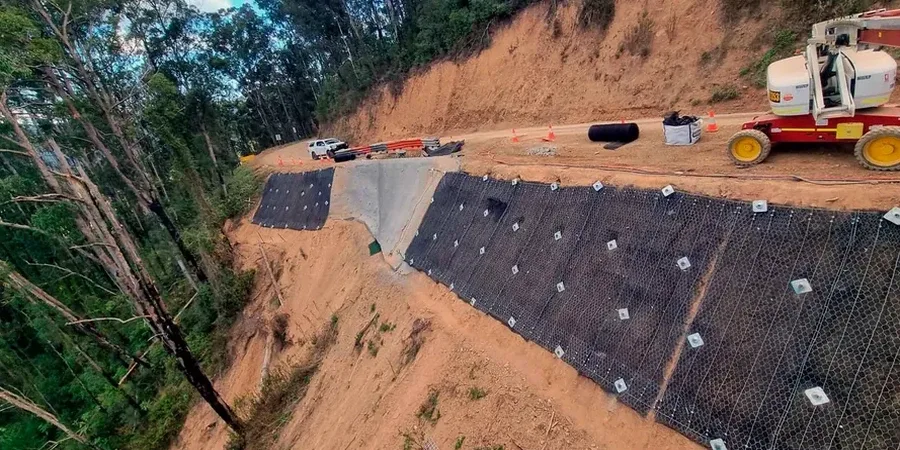
Wellington’s topography doesn’t offer gentle building sites—it demands respect. The city straddles steep ridges carved into weathered greywacke and mantled with loess, all exposed to relentless Cook Strait winds and 1,200 mm of annual rainfall. When a developer prepares a cut platform in Karori or widens an access road above Ngaio Gorge, the margin between a stable batter and a costly slip often comes down to a few degrees of inclination. Our team applies in-situ permeability testing to quantify pore pressure response during storm events, building a groundwater model that informs every stability calculation. The New Zealand Geotechnical Society guidelines require solid investigation before design, and that framework shapes how we approach each fractured, dipping rock slope across the region.
A slope that stands for twenty years can fail in twenty seconds when groundwater pressures spike during a southerly storm.
Common questions
What does a slope stability analysis typically cost for a residential building site in Wellington?
For a typical single-dwelling platform on a Wellington hillside, a site-specific stability assessment including geological mapping, a borehole or test pit investigation, laboratory strength testing, and a limit-equilibrium model generally falls between NZ$2,140 and NZ$6,330. The spread depends on access constraints, depth of investigation required, and whether the slope falls into a higher consequence category under NZGS guidelines. Complex sites with multiple failure modes or those requiring finite-element analysis sit toward the upper end of that range.
How far back from the top of a slope should a building platform be set in Wellington's terrain?
There is no fixed setback distance that works across the region. The required offset depends on the height and angle of the slope, the shear strength of the material, the groundwater conditions, and the seismic hazard at the site. Our analysis calculates the critical failure surface for the specific geometry and soil or rock profile, then applies the appropriate factor of safety to define a stable setback. Wellington City Council typically requires a geotechnical assessment demonstrating a minimum static factor of safety of 1.5 before issuing building consent on sloping sites.
Does a slope stability analysis need to consider earthquake loading in Wellington?
Absolutely. Wellington sits astride the active Wellington Fault and lies within a high-seismicity zone. NZS 1170.5 and the NZGS earthquake engineering guidelines require pseudo-static analysis using a horizontal seismic coefficient appropriate to the site subsoil class and importance level. For critical slopes or those supporting structures with post-disaster function, we often supplement the pseudo-static check with a Newmark displacement analysis to estimate permanent deformation during the design earthquake, giving the structural engineer a basis for assessing tolerable movement.