← Home · Underground Excavations

Geotechnical Design for Deep Excavations in Wellington: A Practical Engineering Approach

Together, we solve the challenges of tomorrow.

LEARN MORE →

Wellington’s geology doesn’t forgive guesswork. Between the weathered greywacke of the hill suburbs, the variable fill along the waterfront, and the notorious Wellington Fault running through the Hutt Valley, any deep excavation here demands more than a standard retaining design. NZS 3404 and the NZGS guidelines provide the framework, but practical interpretation of these standards makes the difference between a project that stays on programme and one that encounters costly surprises at the invert. Our technical team combines site investigation data with numerical modelling to produce staged excavation sequences that work with the ground, not against it. For sites near the harbour edge, we frequently integrate findings from a CPT test to capture the layering of reclamation material over marine sediments, because borehole logs alone miss the thin silt layers that control base stability.

A deep excavation in Wellington isn’t just a shoring problem; it’s a groundwater, seismic, and constructability challenge wrapped into one engineering decision.

Our approach and scope

The design process starts with a calibrated ground model. In Wellington, that means reconciling geomorphological mapping with borehole data and geophysical profiles. We use 2D and 3D finite element software to simulate each excavation stage, factoring in surcharge from neighbouring structures—a constant concern on the tight sites of Thorndon and Te Aro. Shoring options are evaluated against deflection criteria, groundwater control requirements, and constructability. A soldier pile wall with timber lagging might suit a short-duration cut in residual greywacke, while a secant pile wall becomes necessary where groundwater is perched in the looser colluvium of the Town Belt slopes. When the excavation extends below the water table, depressurisation modelling confirms whether passive resistance is sufficient or whether the base requires jet grout treatment. Deep excavation design also overlaps with retaining wall design, particularly where the permanent structure ties into temporary works that will remain partially in service.
Geotechnical Design for Deep Excavations in Wellington: A Practical Engineering Approach
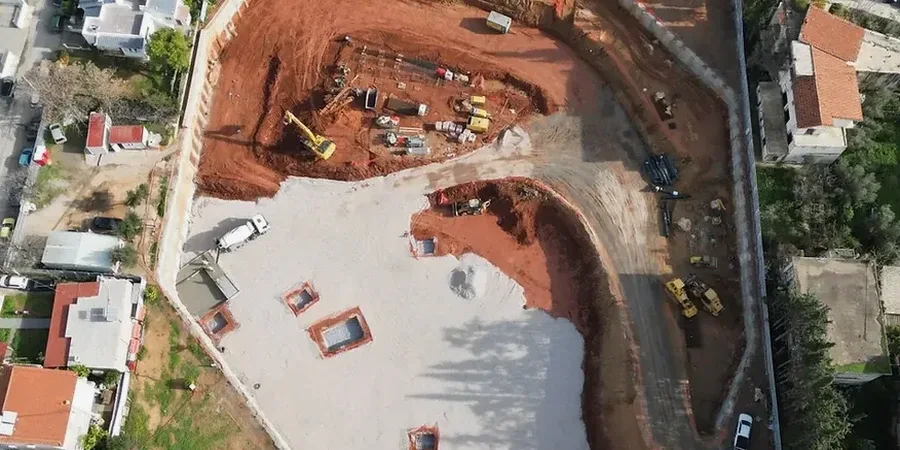
Technical reference image — Wellington

Local ground factors

One lesson from Wellington’s excavation history is that the ground rarely matches the desk study perfectly. Unexpected boulders in the reclamation fill can halt a contiguous pile rig for days. A perched water table in the weathered zone above fresh greywacke can trigger localised slumping in an open cut that looked stable on paper. And then there’s the seismic component: a design that satisfies static equilibrium may still fail the serviceability check under the 500-year return period ground motion, especially if the excavation remains open for several months through the winter. Commissioning an observational method programme—where monitoring data feeds back into the design—reduces this uncertainty. Inclinometers, standpipe piezometers, and survey prisms on adjacent buildings become part of the risk management toolkit, not optional extras. Ignoring base heave in soft ground is the fastest way to lose a floor slab before it’s even poured.

Need a geotechnical assessment?

Reply within 24h.

Email: [email protected]

Watch the video

Typical values

ParameterTypical value
Design standardNZS 3404, NZGS Excavation Guidelines
Seismic load caseNZS 1170.5, site subsoil class per NZS 1170.5
Typical excavation depth6 m to 25 m (basement and infrastructure)
Groundwater controlModelled pore pressure response, depressurisation if required
Shoring systemsSoldier pile, secant pile, diaphragm wall, soil nail
Deflection criteriaServiceability limits per neighbouring structure sensitivity
Site investigation inputCPTu, borehole, geophysics, lab testing (triaxial, direct shear)

Complementary services

01

Staged Excavation Design and Shoring Analysis

Full numerical modelling of the construction sequence, including wall deflections, strut forces, base stability, and groundwater drawdown effects. Outputs include design drawings, calculation packages, and construction-phase monitoring trigger levels aligned with NZGS good practice.

02

Independent Peer Review and Value Engineering

Critical review of contractor-proposed temporary works, focusing on geotechnical assumptions, load paths, and compatibility with Wellington’s ground conditions. We identify opportunities to reduce temporary works cost without compromising safety or programme.

Regulatory framework

NZS 3404: Steel Structures Standard (temporary works design), NZS 1170.5: Structural design actions – Earthquake actions, NZGS Guidelines for Deep Excavations, NZS 4404: Land Development and Subdivision Infrastructure, MBIE Practice Advisory for Seismic Assessment

Common questions

What is the typical fee range for a deep excavation design on a Wellington site?

The fee depends heavily on excavation depth, ground complexity, and the number of construction stages to be modelled. For a single-level basement in competent ground, design work might start around NZ$3,540. A multi-level excavation with groundwater control and an observational monitoring programme can reach NZ$14,460 or more, reflecting the additional modelling and reporting involved.

How do you account for the Wellington Fault in the excavation design?

The fault trace itself is a constraint rather than a direct load, but the seismic hazard amplifies the lateral earth pressures and groundwater response during an earthquake. We apply the hazard spectra from NZS 1170.5 for the site’s subsoil class, and run a separate seismic load case in the finite element model to verify wall stability and serviceability deflections under the design event.

Can the design accommodate staged construction when neighbours cannot tolerate movement?

The reference range for this service in Wellington is NZ$3.540 - NZ$14.460. The final price depends on the project scope and volume.
Location and service area

We serve projects in Wellington and surrounding areas.

View larger map