← Home · Seismic

Base Isolation Seismic Design in Wellington: Engineered Solutions for High-Seismic Terrain

Together, we solve the challenges of tomorrow.

LEARN MORE →

The jump from Te Aro’s reclaimed foreshore to Thorndon’s greywacke hill slopes isn’t just a change in postcode – it’s a fundamental shift in seismic demand. On the flat, deep alluvial soils can amplify long-period shaking that threatens mid-rise frames; up on the terrace, short-period rock motion governs. Base isolation seismic design bridges that gap by decoupling the structure from the ground, but only if the isolator properties match the site-specific spectra. Our Wellington laboratory runs the full characterization chain: borehole shear-wave velocity via seismic refraction to feed site response models, then iterative time-history analysis to size lead-rubber or friction-pendulum units. With the Wellington Fault running barely 2 km from the CBD and a 10% probability of a M7+ rupture in the next 50 years, getting the isolation right isn’t optional.

A 2.5-second isolated period works in the Hutt Valley but can couple with basin-edge waves in Thorndon – site-specific spectra drive the design, not catalog values.

Our approach and scope

The most expensive mistake we see in new Wellington builds is specifying isolators from a generic design spectrum instead of a site-specific one. The NZS 3404 framework requires a full geotechnical investigation, yet some teams skip borehole geophysics and end up with a period shift that puts the structure in resonance with the basin edge effect. That’s when the isolation layer becomes a liability. Our workflow starts with CPT testing to map soft layers and liquefiable lenses, followed by downhole or crosshole surveys that deliver the Vs profiles needed for nonlinear site response. From that data we define the MCE spectrum, establish the displacement demand, and check stability under maximum considered earthquake shaking. In parallel we run stone columns feasibility if ground improvement is required beneath the isolator plinth to limit differential settlement. Every design we issue goes through an internal peer review against the NZGS guidelines for earthquake-resistant foundation design.
Base Isolation Seismic Design in Wellington: Engineered Solutions for High-Seismic Terrain
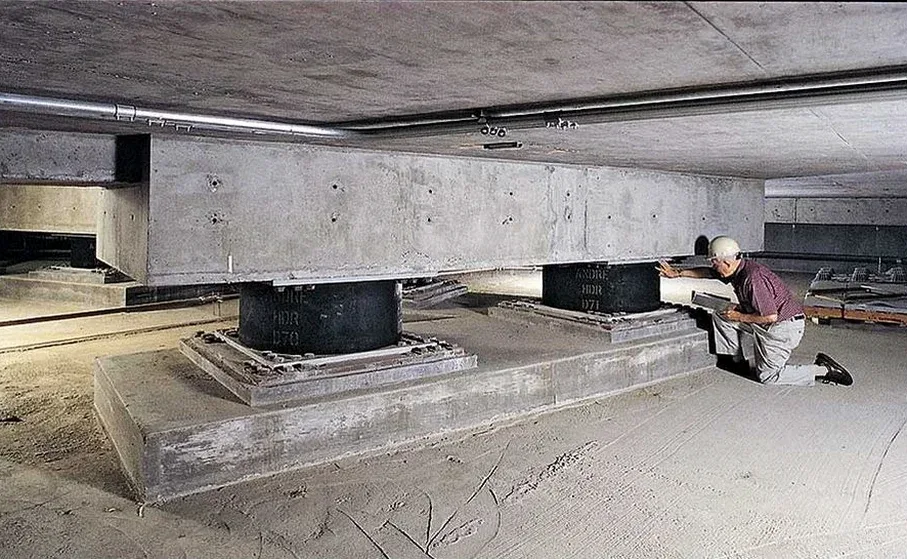
Technical reference image — Wellington

Local ground factors

The dynamic test rig we use for isolator prototype verification runs a 2000 kN vertical actuator paired with a ±500 mm stroke horizontal ram – enough to cycle a full-scale lead-rubber bearing through three design earthquakes in sequence. When we test for a Wellington project, the loading protocol replicates the near-fault pulse characteristic of the Wellington Fault: a large first-half-cycle excursion followed by several moderate reversals. The bearings that pass this protocol show stable hysteresis loops with less than 10% degradation in effective stiffness over the design life. We’ve pulled units that looked perfect after the first run only to delaminate on the third cycle because the rubber-to-steel bond couldn’t handle the cumulative heat build-up. That’s the kind of failure that doesn’t appear in a desktop study but shows up fast on a hot rig in the Seaview industrial area.

Need a geotechnical assessment?

Reply within 24h.

Email: [email protected]

Typical values

ParameterTypical value
Design return period500 to 2500 years per NZS 4203
Isolator types evaluatedLRB, HDR, FPS, triple-pendulum
Minimum Vs30 profiling depth30 m (100 ft) per NZGS guidelines
Displacement capacity checkedMCE displacement + 20% contingency
Uplift restraint designPer NZS 3404 Section 13
Site response method1D equivalent-linear + 2D basin analysis
Lab testing on isolator rubberShear modulus G, damping ratio ξ, aging per ISO 22762

Complementary services

01

Site-specific ground motion & isolator design

Full probabilistic seismic hazard analysis, 1D/2D site response, MCE spectra generation, and bearing parameter specification meeting NZS 3404 Section 13.

02

Prototype testing & acceptance criteria

Dynamic cyclic testing of full-scale isolators with Wellington Fault near-source protocols, plus rubber material aging, creep, and low-temperature verification.

03

Peer review & construction monitoring

Independent design check per NZGS guidelines, isolator installation oversight, and long-term health monitoring plans for the isolation interface.

Regulatory framework

NZS 3404:1997 Steel Structures Standard, Part 13: Seismic Isolation, NZS 4203:1992 General Structural Design and Design Loadings for Buildings, NZGS Earthquake Geotechnical Engineering Practice Guidelines (Module 5), ISO 22762-1:2018 Elastomeric Seismic Protection Isolators (where referenced by NZS)

Common questions

What’s the typical cost range for base isolation seismic design on a Wellington project?

For a site-specific ground motion study, isolator design, and prototype testing support, budget between NZ$7,420 and NZ$13,570 depending on the number of bearing prototypes and the complexity of the site response analysis. Larger or irregular structures requiring 3D nonlinear time-history push the figure higher.

How does the Wellington Fault proximity affect isolator displacement demand?

Near-source forward-directivity pulses can increase peak displacement demand by 30-50% compared to far-field records. Our design procedure explicitly includes pulse-type motions scaled to the NZS 4203 hazard level for sites within 5 km of the fault trace.

Can you retrofit base isolation on an existing heritage building in Wellington?

Yes, we’ve worked on several seismic upgrade projects where the isolation plane is inserted above an existing foundation using temporary jacking systems. The key constraint is usually access for installing new foundation beams under the perimeter walls – we can assess feasibility once we have the structural drawings.
Location and service area

We serve projects in Wellington and surrounding areas.

View larger map