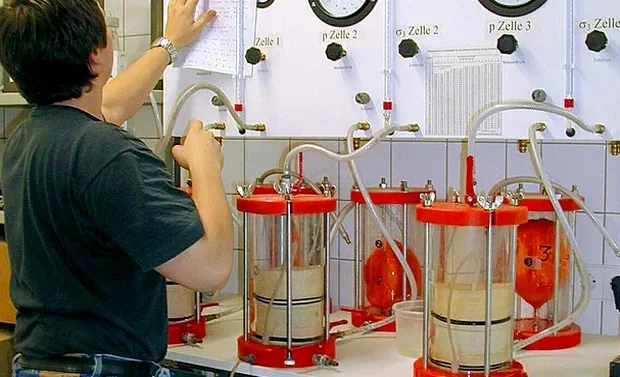
Wellington’s geology runs from weathered greywacke ridgelines to soft coastal alluvium, and the moisture regime is relentless. Annual rainfall in the city averages over 1200 mm, which means subgrade strength can degrade fast once a formation is opened up. A field sample that looks competent on the cutting floor often loses more than half its bearing capacity after four days of soaking. The laboratory CBR test quantifies that loss before aggregate is placed. By compacting remoulded specimens at target density and moisture content, then penetrating them with a standard piston under controlled saturation, the team generates a soaked CBR value that feeds directly into pavement thickness design under NZS 3404. For Wellington subdivisions cut into hillslope colluvium, the result usually determines whether a flexible pavement design can proceed with the planned aggregate depth or needs a thicker structural layer.
Soaked CBR values below 3% in Wellington silts demand either chemical stabilisation or a substantial increase in pavement cover depth.
Our approach and scope
The Terrace Motorway project in the 1970s exposed how variable Wellington’s made ground and residual soils can be, and modern laboratory CBR testing still wrestles with the same issue: the difference between a bulk sample taken from a wind-blown loess pocket and one from a compacted gravelly fill can be 300%. The test procedure follows NZS 4404 methods, with a 4.5 kg rammer and a 450 mm drop compacting material in a standard CBR mould, typically at modified Proctor effort. Soaking is mandatory for most Wellington roading jobs because the water table sits high in the Hutt Valley and around the CBD reclamation zones. A load-penetration curve is plotted, and the ratio of the test load to the standard load for 2.5 mm and 5.0 mm penetration is reported. Where coarse particles exceed 19 mm, the scalping and replacement technique is applied, and the report always flags the particle-size adjustment so the designer knows the value is conservative.
Local ground factors
The mistake that repeats across Wellington subdivisions is assuming that an unsoaked CBR value taken from a trial pit in February is representative of winter conditions. A contractor opens a formation, runs a quick field check, and orders aggregate based on a CBR of 12%. By July, after the water table rises through the fractured greywacke, the same material measures 4%. The pavement starts rutting within the first year. The laboratory CBR test eliminates that gamble by enforcing a four-day soak under surcharge, which mimics the worst-case moisture condition the subgrade will see during the design life. Without it, designers are guessing, and the cost of replacing a failed pavement in a steep Wellington street, where truck access is limited and retaining walls constrain the corridor, runs far higher than the price of a single soaked CBR determination.
Common questions
What does a laboratory CBR test cost in Wellington?
A single soaked CBR determination on a remoulded specimen, including the Proctor compaction curve, typically falls between NZ$190 and NZ$300 depending on the number of points on the moisture-density curve and whether swell monitoring is required. Bulk pricing applies for three or more specimens from the same project.
How long does the soaked CBR test take from sample drop-off?
Allow seven working days. The sample requires moisture conditioning, compaction, a full four-day soak period under surcharge, and then penetration testing. Same-day reporting is only possible for unsoaked granular materials.
When is a laboratory CBR required instead of a field Scala penetrometer?
Wellington City Council and NZTA pavement design guidelines require a laboratory soaked CBR for design input. The Scala penetrometer is useful for site variability checks, but the soaked laboratory value is the one that governs aggregate depth calculation under NZS 3404.
What sample mass do you need for a CBR test?
We ask for a minimum of 25 kg of representative bulk material, double-bagged to preserve field moisture. For granular soils with particles larger than 37.5 mm, 40 kg is preferred to allow for scalping and replacement without compromising the gradation.