← Home · Geophysics

Electrical Resistivity / VES Surveys in Wellington

Together, we solve the challenges of tomorrow.

LEARN MORE →

In Wellington we often see resistivity contrast problems that standard drilling misses entirely. The city sits on a mix of greywacke bedrock, weathered zones, and reclaimed land along Lambton Quay — all with distinct electrical signatures. Our team runs Schlumberger-array VES to map these interfaces without breaking ground. A single sounding can reach 60–80 m depth in under two hours, giving you a clean resistivity profile before you commit to boreholes. On the Kāpiti Coast we have traced saltwater intrusion fronts using the same method. We integrate results with NZGS guideline checks so the data feeds directly into your ground model. For complex Wellington sites, CPT testing provides a complementary mechanical log, while MASW adds shear-wave velocity where seismic response matters.

A single VES sounding in Wellington can map bedrock depth, groundwater, and clay layers in under two hours — no drilling required.
Our approach and scope

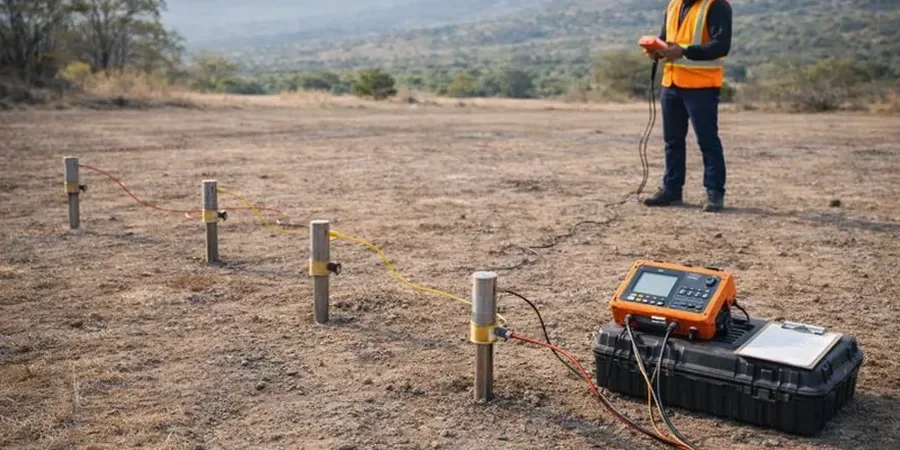
A recent project on The Terrace required depth-to-bedrock confirmation beneath a 6-storey structure. Drill access was tight — no room for a rig. We deployed four VES soundings with AB/2 spacing out to 100 m. The resistivity curve showed a sharp jump from 45 Ω·m to over 400 Ω·m at 11.5 m, exactly where greywacke refusal was expected. Correlation with the single available borehole was within 0.3 m. That kind of agreement is common when the rock is fresh and the overburden is saturated silt. We pair VES with in-situ permeability testing when hydrogeological properties are needed for dewatering design. Our field kit uses a 250 W transmitter and non-polarizing electrodes to keep signal clean in Wellington's often-wet conditions. Each sounding is inverted with RES2DINV and delivered as a layered resistivity model with interpretation notes.
Electrical Resistivity / VES Surveys in Wellington
Technical reference image — Wellington

Local ground factors

The VES gear itself is straightforward: a transmitter box, four electrodes, and heavy-gauge cable on reels. The real risk is poor electrode coupling. Wellington clay can dry out fast on a windy day, and contact resistance above 2 kΩ kills signal quality. We pre-soak each electrode position and check contact resistance with a Megger before every sounding. Cultural noise is another factor — traction substations near the railway corridor or buried services on reclaimed land can inject 50 Hz noise that masks the resistivity signal. We use a frequency-domain filter on the IRIS Syscal and stack readings until standard deviation drops below 1%. If you skip these steps, the inverted model drifts and you end up with a false bedrock depth. That can cost tens of thousands in unnecessary drilling.

Need a geotechnical assessment?

Reply within 24h.

Email: [email protected]

Typical values

ParameterTypical value
MethodSchlumberger vertical electrical sounding (VES 1D)
Max investigation depth80–100 m (AB/2 = 150 m)
Transmitter power250 W DC, auto-ranging
Electrode typeNon-polarizing Cu-CuSO4 porous pots
Typical resolution5–10% of layer thickness
Data processingRES2DINV / IPI2Win 1D inversion
OutputResistivity vs depth curve, layer model table, interpretation report
Standard referenceNZGS / ASTM D6431 (field practice)

Complementary services

01

Deep VES (AB/2 to 150 m)

For bedrock profiling, groundwater exploration, and fault zone mapping. Recommended where target depth exceeds 30 m. Includes layered resistivity model and NZGS-compliant report.

02

Shallow VES (AB/2 to 40 m)

For pipeline routing, fill thickness estimation, and preliminary site screening. Faster deployment with narrower electrode spread. Delivered as 1D resistivity log with lithological interpretation.

Regulatory framework

NZGS Guideline for Geophysical Site Investigation (2019), NZS 4402:1988 Methods of testing soils for civil engineering purposes, ASTM D6431-18 Standard guide for using the DC resistivity method, Eurocode 7 – EN 1997-2:2007 (ground investigation)

Common questions

What does a VES survey cost in Wellington?

Budget NZ$1,140 to NZ$1,520 for a standard single-sounding survey with interpretation report. Price varies with number of soundings, AB/2 spacing, and site access complexity. A multi-sounding program for a larger site will be quoted per project.

How deep can VES see in Wellington geology?

With AB/2 spacing of 150 m we typically reach 60–80 m in weathered greywacke terrain. Maximum investigation depth is roughly AB/2 divided by 2 to 3, depending on resistivity contrast and signal-to-noise ratio.

Can VES replace boreholes entirely?

No. VES is a complementary method. It gives continuous resistivity profiles between boreholes and can target drilling locations more precisely. We always recommend at least one borehole for calibration of the resistivity-to-lithology relationship.

Location and service area

We serve projects in Wellington and surrounding areas.

View larger map