← Home · Ground improvement

Stone Column Design for Soft Ground Improvement in Wellington

Together, we solve the challenges of tomorrow.

LEARN MORE →

A five-storey apartment block near the Te Aro basin. The borelog showed 9 metres of compressible silts and soft clays before hitting weathered greywacke. Standard footings would have settled unevenly. We designed a grid of stone columns to transfer the load past the weak layer. The NZS 3404 framework guided the steel requirements, but the ground improvement logic came straight from the NZGS module on vibro-replacement. In Wellington's harbour-fringe geology, this scenario repeats itself on almost every reclamation site. Our lab runs the triaxial and consolidation tests on the native soil before any column spacing is decided. Data first. Design second. That sequence avoids over-design and keeps the contractor's stone volume within budget.

A stone column is only as good as the soil it replaces. We test both before designing the grid.

Our approach and scope

NZGS guidelines and NZS 4203 seismic provisions set the bar for ground improvement in Wellington. The city sits in a high-seismic zone. A stone column scheme must do two things: control static settlement and resist liquefaction-induced loss of confinement. Our design process starts with a particle-size distribution analysis. The grain-size curve of the host soil dictates whether a wet top-feed or a dry bottom-feed installation method is suitable. Silty soils with less than 15% fines often compact well. Higher fines content requires closer spacing and a clean gravel backfill that meets the filter criteria. We test the stone aggregate alongside the in-situ material. Combining that data with liquefaction triggering analyses under the Wellington seismic hazard spectrum gives the column diameter, spacing, and target modulus. The output is a plan-view layout and a QA/QC specification ready for the ground improvement contractor.
Stone Column Design for Soft Ground Improvement in Wellington
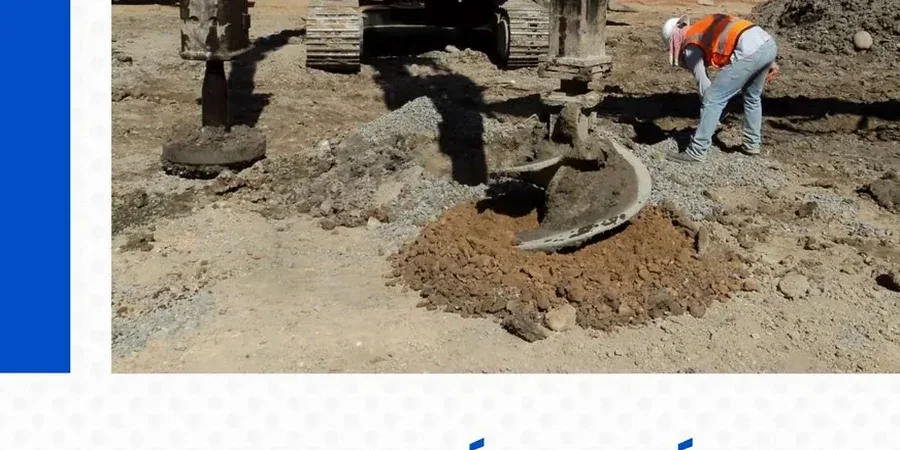
Technical reference image — Wellington

Local ground factors

Wellington's reclaimed land around Lambton Harbour and the Miramar flats carries a double risk: soft compressible layers and a shallow water table. We have seen sites where the groundwater sits at 1.2 metres below ground level in winter. A stone column design that ignores pore pressure dissipation will fail during installation. The risk of bulging failure in the upper 2–3 column diameters is real when the surrounding undrained shear strength drops below 15 kPa. Our lab measures that strength directly with in-situ vane tests and UU triaxial on Shelby tube samples. Another local hazard is the Wellington Fault. Ground shaking can densify loose sands outside the column grid, causing differential movement at the perimeter. We address that by extending the treatment zone 2 metres beyond the building footprint and specifying a load transfer platform of well-graded gravel, tested for plate-load-test performance before structural works begin.

Need a geotechnical assessment?

Reply within 24h.

Email: [email protected]

Watch the video

Typical values

ParameterTypical value
Column diameter0.6–1.2 m
Typical depth range4–18 m
Area replacement ratio10–35%
Target SPT-N post-treatment15–25 blows/300 mm
Backfill stone size25–75 mm clean crushed rock
Design modulus (E)30–60 MPa
Settlement reduction factorn = 2–4

Complementary services

01

Soil characterisation for stone columns

Grain-size distribution, Atterberg limits, and consolidation testing on the host soil. Triaxial UU and CU tests to define undrained shear strength and friction angle for column stability analysis.

02

Stone column design and settlement analysis

Grid layout, area replacement ratio, and settlement reduction factor n. We model stone column groups using the Priebe method and check liquefaction resistance under the Wellington seismic hazard spectrum.

03

QA/QC specification and field verification

Material specification for the gravel backfill. Post-installation verification via plate load tests and SPT energy measurements. We correlate field data with lab-tested parameters to confirm design assumptions.

Regulatory framework

NZS 4404:2010, NZS 4203:1992, NZGS Guidelines for Ground Improvement, AS/NZS 2566.2:2002

Common questions

What depth of soft soil can stone columns treat in Wellington?

We design stone columns for depths between 4 and 18 metres. Beyond 18 metres, the installation cost increases sharply and we evaluate alternatives like driven piles. The weathered greywacke bedrock in Wellington often limits the treatable depth naturally.

How much does stone column design cost for a residential lot?

For a typical residential block in Wellington, the design and laboratory testing package ranges from NZ$2,260 to NZ$8,800. The final figure depends on the number of boreholes, the lab tests required, and the complexity of the settlement analysis.

Can stone columns prevent liquefaction in a Wellington earthquake?

Yes, when designed correctly. Stone columns densify the surrounding soil and provide drainage paths that reduce pore pressure build-up during shaking. We run liquefaction triggering analyses using NZGS guidelines and the Wellington seismic hazard spectrum to verify the design.

What QA/QC tests do you specify after stone column installation?

We specify plate load tests on single columns and groups, SPT or CPT verification between columns, and post-treatment grain-size checks on the installed gravel. Every test is referenced to the lab-characterised baseline properties established during the design phase.
Location and service area

We serve projects in Wellington and surrounding areas.

View larger map