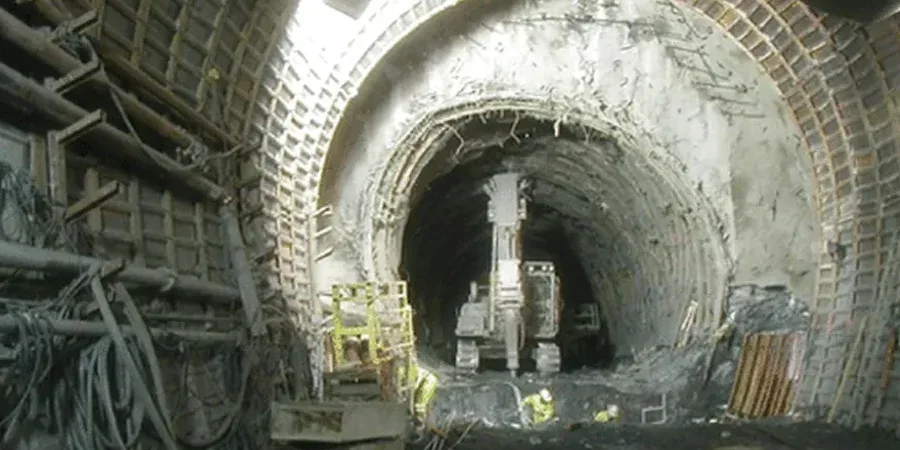
The most expensive mistake we see in Wellington tunnelling is treating the Port Hills loess or reclamation fill like competent rock. A contractor assumes self-supporting ground based on a few boreholes, then hits saturated running sands under Lambton Quay. The face collapses, the street above settles, and the claim lands on the desk before morning tea. We run the full suite of index and strength tests on Wellington formation materials—from the weathered greywacke saprolite to the compressible Holocene estuarine silts—so the excavation method and primary support are designed around real pore-pressure response and undrained shear strength. For alignment options through the Terrace or Mount Victoria, we often combine advanced triaxial testing on undisturbed samples with in-situ permeability profiling to define the groundwater regime before a single metre is driven.
A tunnel face in Wellington reclamation fill can lose stand-up time within minutes once pore pressures equalise—real-time lab data prevents that surprise underground.
Regulatory framework
NZS 3404:2009 Steel Structures Standard (tunnel support and lining), NZS 4203:1992 General Structural Design and Design Loadings for Buildings, NZGS Soil Description and Classification Guidelines (2005), NZGS Earthquake Geotechnical Engineering Practice Module 4: Earthquake Resistant Foundation Design, Transit NZ Bridge Manual (3rd edition) for cut-and-cover sections, EN 1997-1:2004 Eurocode 7 (where specified by client for TBM procurement)
Common questions
What is the typical cost range for a soft-ground tunnel geotechnical investigation in Wellington?
Wellington tunnel investigations typically range from NZ$7,380 for a targeted supplementary testing programme to NZ$31,780 for a comprehensive campaign covering multiple boreholes with advanced triaxial, cyclic testing, and permeability profiling across an alignment. The final figure depends on the depth of the invert, the number of geological units encountered, and whether undisturbed sampling is feasible in the reclamation fill.
How do you sample the soft clays under Wellington's CBD without disturbing the structure?
For the compressible estuarine clays beneath Lambton Quay and the waterfront, we specify thin-walled Shelby tube sampling pushed at a controlled rate from track-mounted rigs. In reclamation fill with obstructions, we use sonic drilling with a core barrel to recover a continuous profile, then trim specimens in the lab for consolidation and strength testing.
Which laboratory tests are mandatory before a TBM drive through the Wellington formation?
The minimum suite includes Atterberg limits and moisture content for clogging potential, point load index and Cerchar abrasivity for cutter wear, and unconsolidated-undrained triaxial tests to define the undrained shear strength profile. When the alignment passes under the Thorndon motorway or railway corridor, we add small-strain stiffness measurement and permeability tests to calibrate the settlement prediction model.