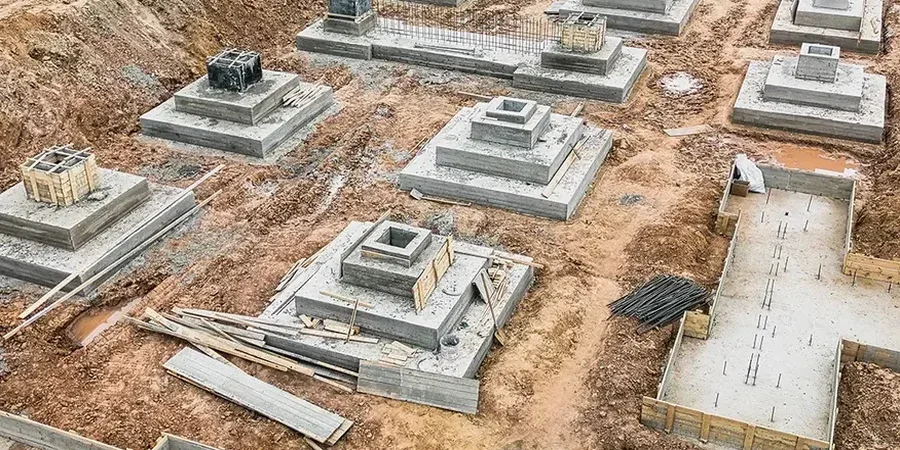
A common oversight in Wellington’s residential and commercial sectors is treating pile design as a standard pro-forma exercise, ignoring the city’s colluvium-filled valleys and proximity to the Wellington Fault. When piling is specified without correlating borehole data to the actual weathered greywacke interface, the result is often excessive settlement or differential movement within the first five years. The technical team addresses this by integrating in-situ testing with site-specific seismic response analysis, ensuring that each pile group works with the ground rather than against it. On sloping sites across Karori or Wadestown, we frequently complement the geotechnical model with a slope stability assessment to verify that the pile cap elevation is outside the potential failure wedge.
In Wellington’s seismic landscape, a pile is not just a structural column underground — it is a dynamic seismic fuse that must absorb and dissipate energy without compromising the superstructure.
Our approach and scope
Wellington’s geography presents a stark contrast between the compact, wind-blown loess on ridgelines and the soft, compressible alluvium in the Te Aro and Miramar basins. This disparity means pile foundation design cannot rely on a single design philosophy; driven piles that perform exceptionally in dense gravels near the Hutt Valley may be uneconomical or technically unsuitable for the marine-sediment layers closer to Lambton Harbour. Our methodology adheres to the NZS 3404 standard for steel piling and the NZGS guidelines for deep foundation capacity, calibrating lateral load models with site-specific p-y curves derived from CPTu data. The process accounts for the corrosive marine aerosol environment prevalent in coastal suburbs, mandating sacrificial steel thicknesses that go beyond the minimum code requirements.
For structures exceeding three storeys, the assessment includes a kinematic pile-soil interaction analysis, verifying that the pile head can accommodate the lateral displacements anticipated during a 1-in-500-year seismic event. The laboratory’s ISO 17025 accreditation ensures that all soil strength parameters feeding into the pile capacity calculations are derived from controlled testing, eliminating the variability often found in field-only estimates. This is particularly relevant when dealing with the fractured rock masses common in the Wellington Peninsula, where rock socket design must consider the anisotropic joint patterns typical of the Torlesse composite terrane.
Local ground factors
A twelve-storey mixed-use development on Taranaki Street encountered a critical design challenge when boreholes revealed a buried paleochannel filled with loose, saturated silts at a depth of 12 meters, directly above the competent greywacke bedrock. The initial proposal for a shallow mat foundation was abandoned after the seismic hazard assessment showed a high risk of liquefaction-induced bearing failure. The pile foundation design was re-engineered to include 900 mm diameter bored piles socketed 4 meters into the rock, using a permanent steel casing to isolate the pile shaft from the liquefiable layer. Without this deep foundation intervention, the differential settlement during a major earthquake could have exceeded 150 mm, resulting in catastrophic structural damage. This scenario, repeated across the reclaimed land of Wellington’s CBD, underscores why pile design here demands a rigorous integration of seismic microzonation data and advanced ground investigation techniques.
Common questions
How does the Wellington Fault proximity affect pile foundation design requirements?
The Wellington Fault’s proximity introduces near-field seismic effects, including high vertical accelerations and large velocity pulses. Pile design must consider both inertial forces from the superstructure and kinematic forces from soil deformation. We apply the NZGS deep foundation guidelines to assess liquefaction-induced lateral spreading and verify structural ductility under NZS 1170.5 parameters, often requiring specific pile-to-cap connection detailing to accommodate ductile hinging.
What are the typical cost ranges for pile foundation design services in Wellington?
Professional fees for a comprehensive pile foundation design package, including geotechnical interpretive reporting and full seismic interaction analysis, typically range between NZ$3,160 and NZ$9,970 depending on the structure's complexity and the number of pile load tests required for verification.
Can pile foundations be designed for Wellington’s steep hill-slope sites?
Absolutely. Steep sites in suburbs like Kelburn or Northland often combine pile foundations with retaining elements. The design must account for the reduced passive resistance on the downslope side and potential slope creep. We integrate the pile design with a slope stability analysis to ensure the pile group remains stable under both static and seismic conditions, often utilizing socketed piles to bypass the shallow, creeping colluvium.