← Home · Geophysics

Seismic Tomography (Refraction/Reflection) in Wellington: Subsurface Imaging

Together, we solve the challenges of tomorrow.

LEARN MORE →

The subsurface contrast between Wellington's CBD and the hill suburbs is stark. The reclamation fill along Lambton Quay bears little resemblance to the weathered greywacke of Kelburn. Seismic tomography maps this transition. Refraction and reflection profiles delineate the interface between artificial fill, colluvium, and bedrock. The Wellington Fault runs through the city core. Its influence on rock mass quality is not uniform. Our team runs P-wave and S-wave lines to capture velocity contrasts that correlate directly with rippability and stiffness. For deeper targets, we pair reflection spreads with MASW to constrain shear-wave velocity profiles in the upper 30 metres. The method serves projects from foundation design to landslide assessment in a city where geology changes block by block.

A P-wave velocity jump from 800 m/s to 2,400 m/s typically marks the colluvium-to-bedrock interface in Wellington's hill terrain.

Our approach and scope

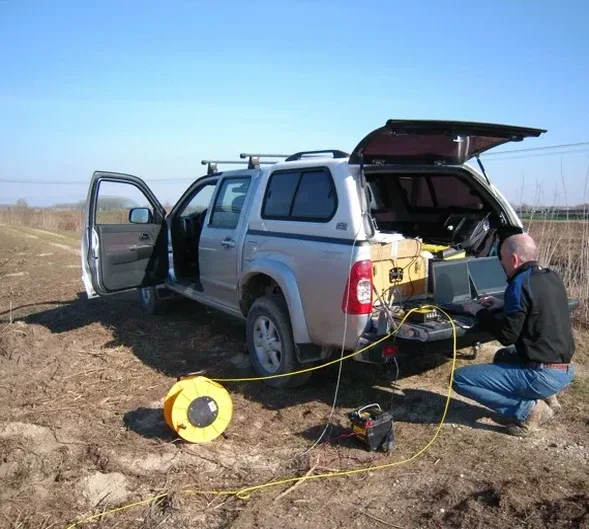
Wellington's coastal exposure and rugged topography impose specific constraints on seismic acquisition. Salt-laden winds accelerate cable connector corrosion. Steep slopes require rope-access deployment of geophone spreads. Our field crew works with 24-channel and 48-channel seismographs, using accelerated weight drops or sledgehammer sources depending on penetration depth required. Refraction tomography resolves velocity gradients within the top 15 to 40 metres. Reflection processing images deeper horizons, often exceeding 100 metres, critical for tunnel alignment studies. We apply first-break picking with automated quality checks and run iterative inversion using curved-ray algorithms. The resulting 2D velocity sections are calibrated against borehole data from SPT drilling where available, reducing interpretation uncertainty in Wellington's complex flysch sequences.
Seismic Tomography (Refraction/Reflection) in Wellington: Subsurface Imaging
Technical reference image — Wellington

Local ground factors

Wellington's greywacke bedrock is deeply weathered in places. Fresh rock can sit beneath 30 metres of completely decomposed material. A refraction survey that stops at first refractor risks misinterpreting a boulder bed or perched water table as competent rock. This is not a hypothetical scenario. Several Wellington excavations have encountered unexpected soft zones below a high-velocity surface layer. Reflection tomography reduces this risk. It images velocity inversions hidden from refraction alone. The NZGS guidelines recommend cross-validation with borehole control on critical infrastructure projects. We combine seismic lines with targeted drillhole data to anchor the velocity model. The Wellington Fault zone adds another variable. Shear zones and crushed rock produce low-velocity anomalies that require careful interpretation to distinguish from weathering effects.

Need a geotechnical assessment?

Reply within 24h.

Email: [email protected]

Typical values

ParameterTypical value
Typical survey line length60 to 240 m per spread
Geophone spacing2 m to 5 m
P-wave source8 kg sledgehammer or 50 kg weight drop
Recording channels24 or 48 channel seismograph
Depth of investigation (refraction)10 m to 40 m
Depth of investigation (reflection)30 m to 150 m+
Sampling interval0.125 ms to 0.500 ms
Data format deliverablesSEG-2, SEG-Y, ASCII XYZ

Complementary services

01

P-wave refraction tomography

First-arrival traveltime inversion for 2D velocity cross-sections. Used for bedrock profiling, rippability assessment, and mapping the base of fill in urban Wellington sites.

02

S-wave and MASW integration

Surface wave acquisition along the same spread to derive Vs30 profiles. Essential for seismic site classification under NZS 1170.5 in a city with highly variable ground conditions.

03

High-resolution reflection profiling

CDP acquisition with tight geophone spacing for imaging fault structures, paleochannels, and deep bedrock geometry on infrastructure corridors.

Regulatory framework

NZS 1170.5:2004 (seismic loading context), NZS 4404:2010 (land development earthworks), NZGS Soil and Rock Description Guidelines, Eurocode 8 — NZS 1170.5 adaptation for site response

Common questions

How long does a seismic tomography survey take on a typical Wellington section?

A single 115-metre refraction line with 24 geophones takes about two hours of field time, assuming pedestrian access and a sledgehammer source. Larger spreads or rope-access terrain add setup time. Data processing and interpretation require an additional two to three working days for final deliverables.

What is the cost range for a seismic survey in Wellington?

Seismic tomography surveys in the Wellington region range from NZ$4,940 to NZ$9,860 depending on the number of spreads, depth of investigation required, and site access complexity. Steep sites requiring rope crews fall at the upper end of the range.

Can seismic methods identify the Wellington Fault on a building site?

Yes, with the right line orientation. High-resolution reflection profiling can image fault splays and offset reflectors if the survey line crosses the feature at a high angle. The crushed rock within fault zones produces a distinct low-velocity anomaly on refraction tomograms. NZGS guidelines recommend combining seismic data with trenching or boreholes for fault avoidance studies on critical structures.
Location and service area

We serve projects in Wellington and surrounding areas.

View larger map