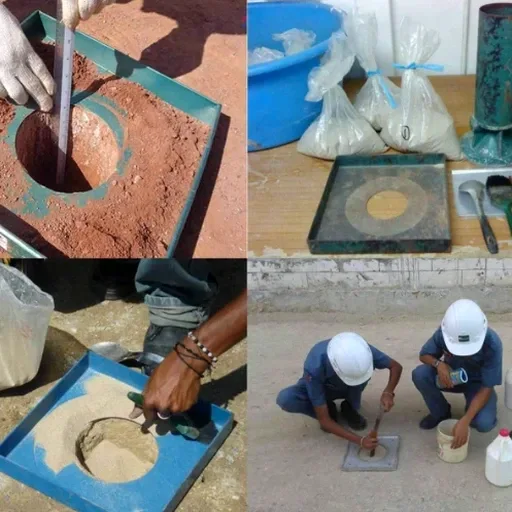
Wellington's geology shifts sharply across short distances: compact greywacke hillsides in Karori give way to soft reclamation silts along the waterfront and loose colluvium in the Aro Valley. This patchwork makes earthwork compaction a variable exercise, where a single specification rarely fits every site. The sand cone test gives us a direct field measurement of in-place density that we can correlate with laboratory proctor values, typically NZS 4402 compaction curves run on site-specific fill. Because much of the city sits inside a high seismic zone — Wellington lies astride the Wellington Fault and faces rupture risk from the Wairarapa and Ohariu faults — poorly compacted structural fill introduces a deformation hazard that amplifies during strong ground motion. Our team runs density checks on trench backfill, pavement subgrade, and building platform fill, often pairing the sand cone with a plate load test when bearing capacity must be verified on the same lift. For sites where imported fill is placed over natural greywacke residual soils, we also run grain size analysis to confirm the material meets the grading envelope specified in the earthworks design.
On Wellington's greywacke-derived fills, a two-percent drop below optimum density can double post-earthquake settlement.
Local ground factors
The contrast between Miramar Peninsula and the Hutt Valley illustrates why uniform compaction specs can be misleading. Miramar sits on weathered greywacke with a shallow water table trapped above the bedrock, so fill placed there generally drains well and reaches density with standard roller passes. The Hutt Valley, by contrast, is underlain by deep alluvial gravels and silts where groundwater sits within a metre of the surface during winter — fill placed in those conditions often bulks and fails density checks unless the moisture is actively managed. The biggest risk we see on Wellington projects is acceptance of fill that passes a sand cone test at the surface but hides a soft lift underneath, something that happens when testing is spaced too widely or the hole depth doesn't capture the full compacted layer. On sites within the Thorndon reclamation zone, where undocumented fill can contain brick rubble and timber debris, the sand cone volume measurement becomes unreliable if large particles are encountered, and we recommend supplementing with a triaxial test on the borrow material to confirm that the laboratory reference density is genuinely achievable with the site materials.
Common questions
How much does a sand cone density test cost in Wellington?
For sites in the Wellington metro area, a single sand cone test that includes field density measurement, moisture content determination, and a report against project specifications typically falls between NZ$200 and NZ$210. Mobilisation charges vary depending on location — jobs on the Kapiti Coast or in Upper Hutt will carry a higher travel component.
How many sand cone tests do I need for my earthworks job?
The New Zealand earthworks specification commonly requires one test per lift per 500 m² of compacted area, or one test per 50 linear metres for trench backfill, but the rate should be increased on Wellington's variable fill platforms. Where the material source changes, or where visual inspection suggests inconsistent compaction, we recommend tightening the spacing to catch isolated soft zones before they are buried by subsequent lifts.
Can the sand cone test be used on coarse gravel or demolition rubble?
The method loses accuracy when the maximum particle size exceeds about 20 percent of the test hole diameter, because large particles create voids that the calibration sand cannot properly fill. For coarse gravels and rubble fills common in older Wellington reclamation areas, we often switch to a water-replacement method or run a companion plate load test to verify that the placed material meets the stiffness requirement even if the density reading is questionable.